Most agency owners I talk to are running hard. The question I keep asking is — what are they running on?
For a lot of people, it’s momentum. It’s a conference they just left, a book they just finished, a conversation that lit them back up. And that fuel is real — but it burns out fast. A few weeks pass, the inbox fills up, and the fire is right back where it started.
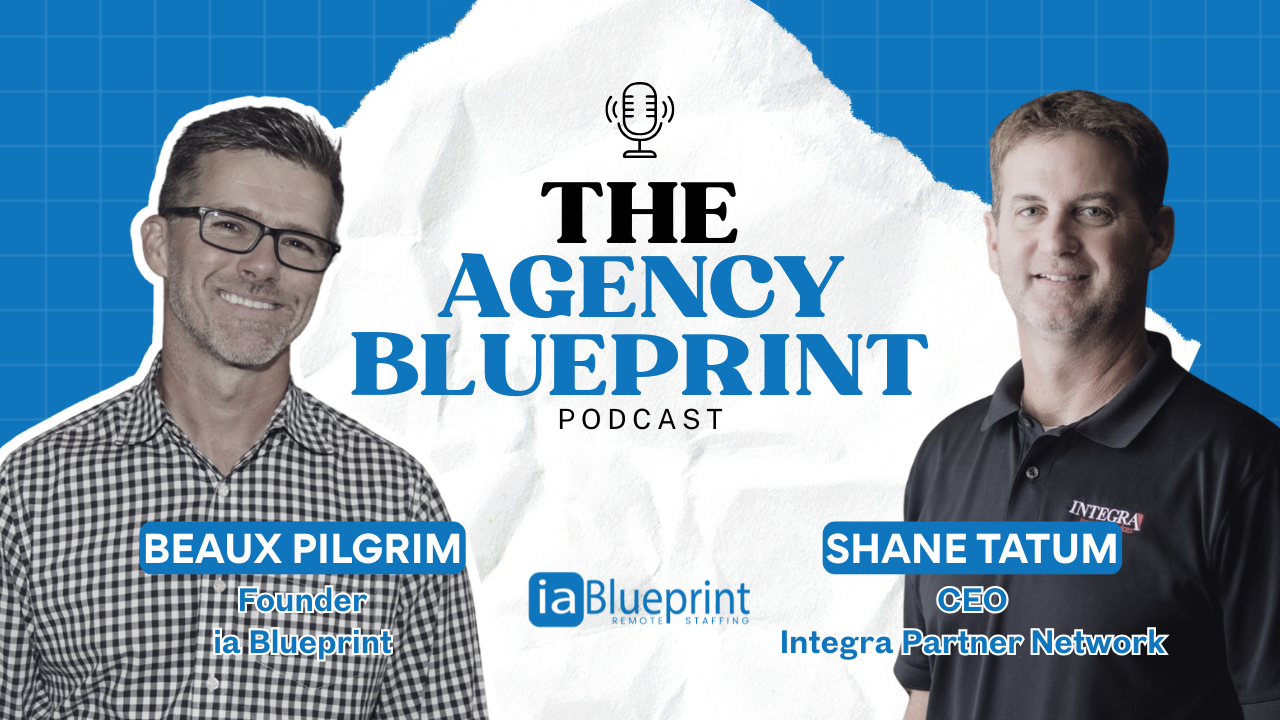
Shane Tatum has a different kind of engine. And after sitting down with him for the Agency Blueprint podcast, I think it’s one of the most important distinctions between founders who plateau and founders who keep building long after everyone else has stopped.
Shane is the president and CEO of Integra Partner Network, a boutique independent agency network operating across Texas, Louisiana, Georgia, Alabama, and growing. What started as a sleepy East Texas retail agency his stepfather Rex purchased in 1983 has become a multi-generational organization with 140 partner agencies and a leadership team built to outlast any one person — including Shane.
But before the network, before the leadership team, before any of it — there was a kid from Nacogdoches watching his single mom work hard and figure things out on her own.
The Kind of Motivation That Doesn’t Need a Conference
Shane calls it intrinsic motivation, and he’s quick to say he thinks it’s learnable — but he’s also honest that not everyone has found it yet.
“If you can become intrinsically motivated, where you don’t need that, you don’t need to go to that rah-rah event, you don’t need to go to that conference to really want to be successful… then I think you are going to win.”
He uses a church camp analogy that I think every business owner has lived through. Kids go off to camp, come back on fire, and within a month they’re right back to the same patterns. The same thing happens after conferences. You leave fired up, full of ideas, ready to change everything. And then real life hits.
“That steam’s got to come intrinsically. It’s got to come internalized.”
Shane traces his own drive back to two things: a single mom who modeled hard work without complaint, and a competitive fire developed through athletics that never really turned off. It became less about beating other people and more about a constant, internal game he plays against himself. As he puts it — they never reach a level where it’s okay, I’m good. That restlessness isn’t exhausting for him. It’s fuel.
The Small-Town Agency That Launched Everything
In 1983, Shane’s stepfather Rex bought a tiny insurance agency in Huntington, Texas — population two thousand. Shane joined it in June of 1995, fresh out of college with no insurance background and what he cheerfully describes as “all the knowledge of the world.”
Rex handed him the accounting. The payroll. Everything he hated. And in doing so, accidentally gave Shane something most agency owners never get — a complete education in every corner of the business.
For three or four years, Shane produced business the traditional way. Personal lines, commercial lines, a generalist wearing every hat. He was moderately successful and deeply unfulfilled. The carrier relationships were a constant struggle — they were in a geography where carriers wanted production, but the market size couldn’t deliver it alone.
Then, in late 1998, he read a PIA study on something called clusters — before agency networks and aggregators were common terms. Something clicked. He loved meeting people, loved talking about the business, loved the idea of helping other agents solve the same problem he was living. In 1999, he launched the first version of what would eventually become the Integra Partner Network.
It didn’t immediately work. The 2006–2008 market turned hard, business was leaving out the back door, and the model had real leaks. In 2010, they went back to the drawing board and relaunched with what Shane calls the partner agent program.
“That program changed the game for us. It fixed the leaks of the first program and just created a much better model for both our insurance company partners and for the agent we were working with.”
Today, roughly 95% of Integra’s partners came from either the captive/exclusive agency world or were producers ready to start their own shop. The network gave them a launching pad — the same thing Rex’s little agency had given Shane.
The ‘Hit by a Bus’ Conversation That Built a Leadership Team
In 2015, Rex passed away after a battle with cancer. It left a hole that was more than personal — it exposed a structural vulnerability Shane had never had to think about before.
“If I get hit by a bus, my family’s in trouble.”
That phrase — the one he and Rex used to use to start their succession conversations — had a different weight now. There was no one on the other end of it anymore.
Shane spent a lot of time in prayer and study, and came out with a clear conviction: he needed to build a leadership team that could carry the business if something happened to him. Not just fill roles — but hold the weight.
Between 2017 and 2019, he built that team. And the people he brought in are still there today, which he knows is rare. But building the team was only half the lesson. The harder half was learning to actually let go.
“If you give responsibility, you got to give authority. You can’t give responsibility without authority.”
His team told him — more than once — that he was clogging things up. That he was handing them accountability without handing them ownership. It’s one of the most honest things a leadership team can say to a founder, and one of the most useful things a founder can hear — if they’re willing to listen.
Thinking Is Working
Here’s the reframe that I think a lot of founders need permission to make.
Shane gets up around five in the morning. He does some Bible study, some quiet time, answers a few emails, drinks coffee with his wife. He moseys into the office around eight-thirty. And for years, he felt guilty about it.
“I had to learn that thinking is working.”
He was raised by boomers. The old rule was simple: if you’re not at your desk, you’re not working. But Shane recognized that he was thinking about his business fifteen hours a day, seven days a week. On the tractor. Feeding hay to the cattle his family rekindled from Rex’s old love of the land. In the quiet before everyone else woke up.
That’s not slacking. That’s the work that only the founder can do — and it only becomes available when you’ve built a team that doesn’t need you in every conversation.
Today, Shane estimates he spends about 80% of his time working on the business, not in it. The leadership team handles the day-to-day. He focuses on where things are going.
His advice to founders still figuring out when to make that shift: focus on the one thing driving your revenue until the profits can fund the next phase. Don’t chase shiny objects. Don’t try to build five things at once. Build the engine, then use the engine to build everything else.
And when you do start handing things off — hand them off completely. Responsibility without authority isn’t delegation. It’s just a longer to-do list wearing a different hat.
You can connect with Shane on LinkedIn and follow what he’s building at Integra Partner Network.
At ia Blueprint, we work with agency owners who are ready to stop doing everything themselves. Whether you’re building a leadership team, offloading admin work, or just trying to buy back a few hours each week, the right virtual assistant can change the equation. If you’re curious about what that looks like, book a discovery call. I’d be glad to walk through where you’re at and what’s possible.