
Too often, founders burn themselves out by making themselves indispensable. They grow overwhelmed with handling every contingency and spearheading every initiative. In doing so, they become the bottleneck that holds back their company’s progress.
Sound familiar? If so, it’s time to change course. As a leader, you need to focus on what drives you — whatever haunts or chases you, pushing you to take risks and propel your vision forward.
To make room for that to happen, you need to empower others to handle the daily work independently. Giving employees more autonomy will also increase their productivity and morale, research has shown. By fostering high-performing teams, you’ll ensure your operations will continue seamlessly as you step aside to focus on more pressing things. Your business will flourish as you focus on leveraging your gifts to carry out your highest-value activities.
Building autonomous teams — and entrusting them with key functions — will also let you go on vacation without worrying about whether everything will fall apart. That means you can relax and recharge instead of keeping your nose to the grindstone day in and day out.
So, what’s the secret to building a high-performing team that lets you devote your full focus to your core priorities? Let’s dive into that now.
Figure Out How to Fire Yourself

Take a look at my Leadership Delegation Focus Matrix, which I’ve talked about in previous posts. Similar to tools developed by Stephen Covey and Dan Martell, this matrix will help you set priorities as a leader. We regularly use this tool with our clients as we discuss what tasks and functions they need a virtual assistant to handle. Think about which quadrant each of your daily activities falls into.
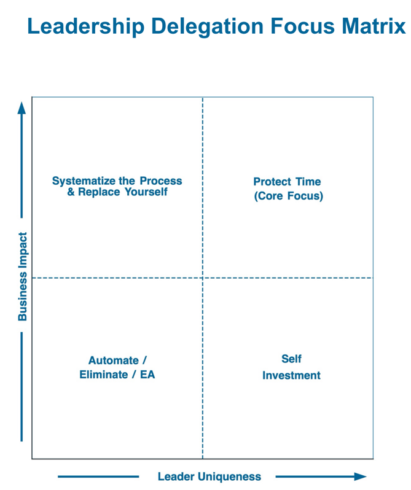
Then, focus on firing yourself from everything that doesn’t fall into the right two boxes. For me, this means being the face of my company’s marketing and spearheading our sales efforts. Eventually, I’ll train someone else to direct sales as well.
Once you figure out how to fire yourself from everything but these couple of priorities, you’ll have time to continuously move your business forward. This will give you more hours in the day to focus on what drives you. Here’s how to make that happen by building autonomous teams.
Shift Your Mindset
Change your mindset around time and money. Don’t think of hiring the right people as an expense — think of it as a way to grow your business and increase your revenue. You’re not taking a pay cut; you’re investing in your future. You’ll scale faster when you have good people in the right positions.
With that in mind, think strategically about how new hires can help you scale. Reorganize roles to be more highly focused around specific functions. Then, hire people who specialize in the things that you and your current staff aren’t good at. Choose people who are good at working independently as well as collaborating, too. A team of self-directed people who also communicate clearly will stay on track even when you step aside.
Systematize Your Processes
Create processes for areas of focus that are central to the business but don’t require your unique skill set. Things like sales, HR, renewals, onboarding, and marketing fall into this category. Equipped with solid processes, you can bring new people on board more effectively.
Designate Decision-Making Power
Specify who has decision-making authority for the smaller things, so you can focus on the bigger ones. Appointing an employee as project leader? Clarify what authority they hold. Reorganizing roles around functions? State what decision-making power each person has. That way, operations can continue without your intervention in every micro-decision. This will free up your time to hash out strategic decisions instead of getting into the weeds about the small stuff.
Outline Protocols for Handling Problems
Of course, you can’t anticipate every potential problem that could crop up. But by outlining clear protocols for different types of challenges, you’ll empower your team to handle things autonomously whenever possible.
Resist the urge to intervene immediately when your team is struggling, too. Instead, give them time to figure things out for themselves. That way, you won’t burn yourself out on the things that don’t truly require your attention. Plus, you’ll help them build their problem-solving muscles — and sometimes, they might come up with better ideas than you would’ve on your own!
Be a Sounding Board
Start acting like a coach instead of a boss. That means helping people find their own solutions to challenges whenever possible.
Try asking questions like these if you feel like your team is stumped:
- What have you tried so far?
- What is holding you back?
- What type of support could help you move forward?
These questions will help people learn to proactively solve problems instead of always taking direction from you.
Mentor Them to Success
Through continuous mentoring, you’ll help people strengthen their own leadership skills. They’ll start taking more initiative to find solutions and lead team efforts on their own. By investing a small amount of time in mentoring, you’ll guide people to become leaders in their own right. They’ll then be able to lift more of the burden of mid-level responsibilities from your shoulders. As your company grows, you can also pair employees up with other senior staff members who can mentor them.
To mentor people effectively, talk one-on-one about their strengths and career ambitions. Help them make a growth plan that lets them reach stepping stones to success. Give them stretch assignments that help them hone their strengths, along with plenty of feedback.
By taking all of these steps, you’ll foster high-performing teams and build momentum toward your overarching goals. Then, use some of the time you’ve gained back to keep enhancing your own leadership skill set.
Reinvest in Yourself
Continuously reinvest in yourself so you can bring more value to the business. As you work to predict future needs, you can upskill as a leader to meet them. Schedule time for personal development, set learning goals, and log your progress so you can track how you’ve grown. Taking webinars, reading and reflecting, and talking with your own mentors can all be part of a well-balanced learning plan.
Keep auditing your time to see what other duties you should give away to someone else, too. Then, make decisions on what to hire or train for, based on what the business needs. Over time, you can offload more tasks and functions while narrowing your focus to your most crucial priorities.
Now you know the secret to building a high-performing team — hiring the right people and empowering them to work as independently as possible. By structuring your business around functions and building autonomous teams, you’ll keep things running as efficiently as possible. This will let you focus on top-level priorities while everyone else handles the rest.
Want to learn more about how hiring the right virtual assistant can help you build an autonomously functioning team? Book a discovery call. I’ll discuss how our skilled VAs have helped other clients successfully scale their businesses. If you’re new to running a remote or hybrid workforce, I’ll also be glad to share guidance on integrating a virtual employee onto your team.