
What is an hour of your time worth to your company?
Last week, how much time did you spend doing work valued at $25 to $40 per hour? (This includes things like answering emails, booking your own travel, scheduling, data entry, or organizing files.)
If you said more than 8–10 hours, it’s time to hire an executive assistant. Period. That’s your decision trigger.
For most small business owners, it takes a crisis moment to start working smarter. They’re spending many hours each week on time-consuming tasks, with little time for the things that can move the business forward. They know they need to do something or they’ll stagnate, but they have no idea how to find the time to make it happen.
So, why hire an executive assistant?
Most small businesses struggle to keep up with the workflow coming in. That’s a big part of why 70% of small businesses fail. Leaders resist delegating tasks, trying to do everything themselves — one of the top three reasons why small businesses often can’t keep up with their growing demands. Those who make it work nights and weekends, devoting far more time than they would if they worked for someone else. Only a small portion end up in a better position — in terms of finances and quality of life — by owning a business. Most of this comes down to time-management, learning to delegate, and making the right hires.
Benefits of an Executive Assistant
Thoreau said, “There are a thousand hacking at the branches of evil to one who is striking at the root.” Too often, we spend all our energy trying to fix results or symptoms, instead of going to the root and fixing what happened there.
The root here is the business owner, who needs to take control of their schedule by making smart choices. The results will reverberate throughout the organization.
Here are some typical outcomes that leaders see when they hire an executive assistant:
- Better attention to detail and accuracy
- More efficient scheduling
- Improved team alignment
- Strengthened credibility and professionalism
- Ability to focus on strategic planning, leadership, and growth.
Hiring someone to free up an executive’s time can make a massive difference in the company’s success. The executive assistant won’t just be handling tedious tasks — they’ll be giving back time to the leader for the things that move the business forward. And they’ll help you build trust with clients.
A good executive assistant is a time-management wizard. They also handle duties that take careful thought, planning, and oversight, making them a tremendous asset to your organization.
What Tasks Do You Need an Executive Assistant to Handle?

An executive assistant can greatly increase your efficiency by letting you focus on your core priorities. Let’s explore how this works.
Tasks an Executive Assistant Typically Handles
An executive assistant usually takes care of a range of tasks like these:
- Managing your email inbox, responding promptly and professionally to requests
- Coordinating your calendar (and optimizing it for productivity)
- Planning your travel and sharing detailed itineraries
- Preparing meeting agendas and talking points
- Taking notes during meetings
- Managing files, using a well-organized system
- Drafting and formatting documents
- Managing personal tasks, like appointment-setting
- Drafting internal communications
- Producing expense reports
Because organization is their superstrength, a virtual executive assistant will probably do many of these tasks better and more efficiently than you would. In some cases, an EA can also act as a project coordinator, sending out deadline reminders and ensuring people complete tasks on time. An EA may also compile research and write briefs or talking points on key topics. As the EA grows more familiar with your work, they’ll be poised to take on responsibilities like these.
Using the Delegation Focus Matrix to Protect Your Time
Here’s how to assess whether it’s time for an executive assistant.
- Quantify how many hours per week you’re spending on those lower-level tasks, like the ones on the list above.
- Identify the bottlenecks — the tasks on your plate that aren’t getting resolved in a timely way.
- Define the top one or two responsibilities that deliver the greatest value, like securing partnerships and sales, making key hires, outlining strategic plans, leading your team, and personal growth work.
Then, you can block out time first for the things that add the greatest value.
In The 7 Habits of Highly Effective People, Stephen Covey presents a framework for evaluating the urgency vs. importance of tasks. This 4-quadrant matrix helps leaders assess which tasks to offload and prioritize. Dan Martell provides a similar matrix for prioritizing your taskload. I’ve developed a hybrid between the two that we use with our clients.
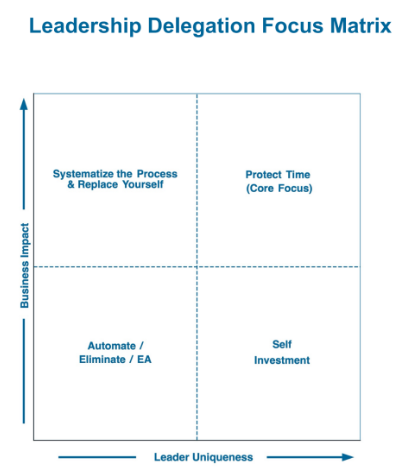
This framework will guide you in how to protect your time by minimizing interruptions and busy work. As you look at your taskload, consider which quadrant each one falls into. Basically, you want to be removing everything that falls into the left two quadrants from your to-do list. That could mean automating it, delegating it to an assistant, or hiring a new staff member for tasks in specialized areas like sales or accounting.
Ask yourself these questions as you review the tasks on your plate:
- Can it be easily automated? Using intake forms, email templates, and CRM workflows can make some repetitive tasks effortless.
- Can you easily train someone else to do it just as well (or almost as well) as you? And since your EA will be able to devote more focus to it than you can, they might even do it better. HR tasks, sales, accounting, and marketing are a few examples.
- Does it require your unique gifts and have a huge impact on the business? Protect your time for these activities. Things like launching strategic partnerships, negotiating with vendors, and developing your vision and overarching plans for the year fall into this category.
- Will it enhance your skills as a leader over the long-term? Self-investment activities aren’t urgent, but they shape your ongoing growth and leadership.
Before pairing clients with a virtual executive assistant, we ask them a few discovery questions to define their exact needs. We ask about their top 1–2 contributions to the business, so they can plan their schedule around those needs. Then, we help them identify the 3 tasks they most need to offload in order to make that happen.
Why I Hired a Virtual Executive Assistant
I know from experience what a difference hiring an executive virtual assistant can make. In my company, I was trying to build a social media presence, develop promotional materials, and handle a broad range of other tasks. I’d become the bottleneck holding us back.
I needed to protect my time for high-level sales and marketing duties — for being the face of the company, building relationships with key clients, growing my leadership skills, and guiding the team to success. So, I hired a marketer to help create a streamlined plan.
It was a good plan, but I still felt a bit deflated. How on earth would I find time to carry it out? I was still the bottleneck.
That’s when I knew I had to hire an executive virtual assistant. And it was hands-down the best decision I could’ve made. Since then, I’ve been able to spend 80% of my time on high-level duties. My executive assistant, Xie, maintains the content calendar and handles countless other tasks. In turn, I’ve gained back many hours each week for core activities, which has made a massive difference by letting us successfully expand.
A virtual executive assistant can be a leader’s greatest asset. It’s not just about the tasks they handle — it’s about the time you get back for what delivers the most value. And by keeping you well-organized and responding promptly to clients, a virtual executive assistant will help project an image of professionalism. That’s why hiring an executive assistant won’t just save you time — it can be a true game-changer for your business.
Wondering, “Should I hire an executive assistant?” Or do you want a more in-depth understanding of how a virtual executive assistant can strengthen your business? Let’s schedule a call. We’ll walk through some introductory questions that will help us get to know you and your needs. Along the way, you’ll learn how an executive assistant can give you back time for the things that deliver the greatest value.