
Leadership coach and author John Baldoni says, “If you want to work 160 hours a week, don’t delegate.”
But as the business leader, we too often want to be the hero. We’re afraid to pass off responsibilities, believing we’re the only one equipped to handle them. Because we don’t devote enough time to the things that really grow the company, we hold back its success.
In reality, being the “hero” means knowing when to hand things off — and how to set priorities as a leader.
Why is delegation important for a leader? Gallup found that leaders who delegate generate 33% more revenue for their business. Instead of being the bottleneck, they’ve figured out how to enhance its success through smart talent management. Yet 75% of business leaders have lower delegation abilities.
Of course, you can’t (and shouldn’t) delegate everything. To stop being the bottleneck, I had to take a hard look at which tasks truly demanded my attention — and which ones were becoming distractions. By handling too many of the latter, I was both derailing my own focus and creating a backlog of tasks that needed to be done.
Good delegation will bolster your resilience as an organization, too. It shows you trust people, gives them the chance to stretch their comfort zone, and helps them grow their problem-solving skills. If you never entrust them with higher-level tasks, your team will stagnate.
So, how to get started? I’ll tell you about my own journey to becoming an effective delegator, sharing what I learned along the way.
Defining My Core Priorities
By identifying my core focus, I learned what to weed out from my task list. This is where good delegation starts.
Your core focus is what drives the business forward. It creates the most revenue and leverages your area of expertise. Everything else can be offloaded — either now or, hopefully, in the near future.
How to set priorities as a leader? Take a look at my Leadership Delegation Focus Matrix. The things that fall into the top right quadrant require your distinct gifts. You need to protect your time for these activities above all else. This underscores the importance of delegation as a leader.
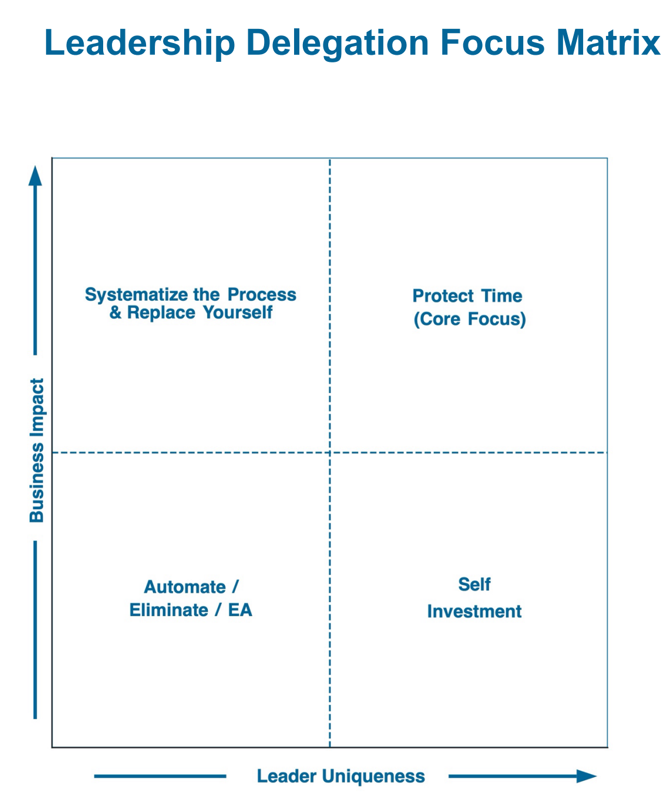
Self-investment, in the bottom-right quadrant, is also important for your company’s long-term future. Essentially, everything in the right two quadrants can’t (or shouldn’t) be offloaded.
On the other hand, the tasks that fit into the left two quadrants can be systematized, automated, or just plain eliminated. They shouldn’t be dominating your focus. Ideally, they aren’t even things you need to think about on a daily basis. Assign them to someone else, or start strategizing on how and when you’ll do that.
My core focus needed to center on presenting the right message to the public about who we are and what it means to work with us, I realized. Fostering a strong culture and supporting my leadership team was the next most important priority. Then came self-investment — growing my own leadership skills. I’m constantly working to improve as a leader and business owner; that’s a journey that will never be completed. Every leader should carve out time for personal growth, no matter their level of experience.
To determine your core focus, list out all the tasks you handle on a regular basis. Then put them in the appropriate quadrant within this matrix. Now you have a good idea of which ones to delegate. Instead of acting as the bottleneck by trying to handle it all, you can start handing things off to other capable people.
Systematizing Processes

Delegating means not just trusting your people, but trusting your processes. Design processes that you can trust and replicate over the long-term. This will let you hand them off to the right people and know the job will get done well. Your goal as a leader should be to systematize processes and replace yourself whenever possible.
In my company, I currently handle our accounting and sales. But eventually, I’ll hire other people to bottom-line both of these functions. To hand them off, I’ll outline the steps each process involves. I’ll map out what the customer journey looks like for us, describing what actions to take at key intervals to nurture these relationships. And I’ll detail my processes for preparing financial statements and budgets. Incoming staff may have a strong foundation in these tasks, but this will help ensure consistency.
Anticipating Future Needs
To delegate well, you also need to predict emerging needs. I realized that I needed to stay in tune with what would benefit my company down the road, so I could prepare for it now. I’m working to get more proficient at messaging, for example. At some point, my executive assistant, Xie, might lead a team focused on strategic messaging, and I’ll need to prepare her for that increase in responsibilities.
Look for the growth opportunities in these future needs. Who has complementary skills that could make them a great fit for one of these roles? Give them chances to stretch their skills in the meantime. For example, Xie is helping me brainstorm on and fine-tune our messaging, building her skills in this area.
Or, for another example, say you’re planning to create a customer renewals department. You could ask your executive assistant to start developing a training plan for these staff. Laying this groundwork will streamline your efforts.
Narrowing Your Focus

Over time, I’ve gradually shifted some tasks from the “Protect Your Time” category to “Systemize the Process.” As a result, I’ve narrowed the scope of activities under “Protect Your Time,” and I’ll continue working to narrow my focus further. Today, I spend 70–80% of my time working on a shorter list of higher-priority activities. This not only brings much less stress and decreases the hours I work; it also drives a massive upsurge in our growth.
That’s because I’m now able to focus on the things that generate more value. You may have heard of the 80/20 rule: the idea that 20% of your business activities produce 80% of the profits. Every leader should strive to identify the 20% of activities that produce the greatest value and increasingly narrow their focus on them. By doing less, you’ll be doing more.
To put it another way, your number-one job is to figure out how to fire yourself from as many things as possible. As you build trust with your employees, consider whether they can handle these types of mid-level duties:
- Acting as project or department manager. This requires strong organizational and leadership skills.
- Developing training materials and protocols. They probably know the ropes better than you, after all!
- Researching new software programs to consider adopting. They could share insights and recommendations based on their findings.
If a task is too complex for one individual, consider delegating it to a team. Break it into clear pieces that fit different employees’ skill sets.
Effective delegation doesn’t happen overnight. Instead, it takes careful preparation and thought. And sometimes it’s a multi-stage process. For instance, you can delegate the bulk of a task to an employee while still helping them get started and wrap it up. Soon they’ll probably be able to handle the whole thing on their own.
You may have already grasped the importance of delegation as a leader. But now, you have a solid understanding of how to get started. As you work to streamline your approach, ask others for their input. Continuous feedback will help you evolve as a leader. Abraham Lincoln famously placed political rivals in his cabinet so he’d gain honest and unfiltered opinions. If people voice ideas about how your team could work more efficiently, listen to them!
Ready to think about delegating some of the tasks on your plate to a virtual assistant? Set up a call. I’ll be glad to share some examples of how our VAs and executive assistants have freed up our clients’ time so they can focus on building their business. With our 12-step hiring process that results in 90% retention, we find people with the expertise, skill, and dedication our clients need.